
Algae Bloom Casts Environmental and Economic Shadows Over South African Reservoir
4 min read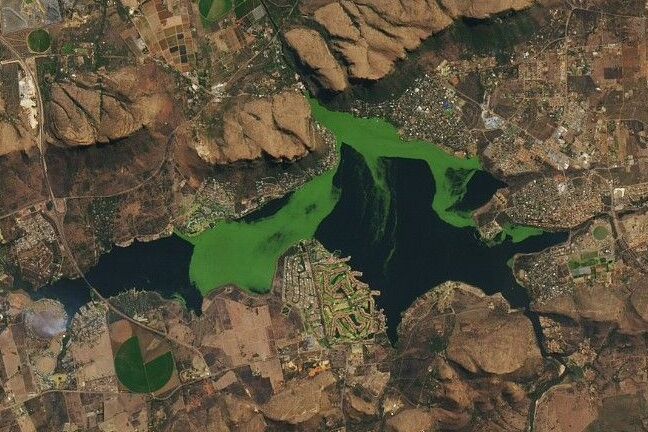
Johannesburg, South Africa (Reuters) – A vast bloom of algae swirling across the surface of a key reservoir in South Africa has raised significant environmental and economic concerns. Satellite images captured by NASA’s Earth Observatory recently revealed extensive green swirls on the Gariep Dam, South Africa’s largest water supply reservoir.
This phenotypic event, primarily observed through April 2023, underscores growing worries over water quality degradation, the impact on aquatic ecosystems, and implications for the region’s human inhabitants who rely heavily on this reservoir for drinking water, agriculture, and recreational activities.
Environmental Concerns
The phenomenon of algal blooms occurs when algae populations reach unnaturally high concentrations, often due to excess nutrients such as nitrogen and phosphorus from agricultural runoff, wastewater discharge, and industrial pollutants. In the case of the Gariep Dam, these nutrients have likely reached a tipping point, creating a perfect storm for algae proliferation.
These blooms can disrupt aquatic ecosystems by blocking sunlight, depleting oxygen levels, and releasing toxins detrimental to both humans and wildlife. “When you have a large-scale algal bloom, it effectively diminishes the quality of the ecosystem, making it uninhabitable for numerous aquatic species,” explains Dr. Nerine Ristow, a senior ecologist at the South African Institute of Aquatic Biodiversity.
Environmental groups warn that such deterioration in water quality could have a cascading impact on local species, leading to a loss of biodiversity and the potentially collapse of the local fishing industry, an essential economic contributor for communities around the reservoir.
Health Risks
The presence of certain algae species can result in the production of toxins that, when ingested through water consumption, can pose significant health risks to humans and animals. While not all algae blooms are toxic, the potential for harm necessitates rigorous testing and monitoring.
A 2023 report from South Africa’s Department of Water and Sanitation underscores the urgency of mitigating these risks through improved water management practices. “The challenge lies in tracking and treating these blooms before they release toxins, which requires early detection systems and rapid containment measures,” says Simon Malatji, a water quality specialist with the department.
Economic Implications
Beyond environmental and health concerns, the bloom also threatens regional economic stability. Farming operations surrounding the reservoir are heavily dependent on its waters for irrigation. As the blooms proliferate, water treatment costs soar, compounding strain on financial resources of local farming families and potentially raising food prices in an already struggling economy.
Moreover, tourism, which plays a crucial role in supporting the local economy through recreational activities such as fishing and boating, is likely to see a downturn. “Tourists are understandably deterred by blooms which reduce the aesthetic and recreational appeal of the reservoir,” says Marcia Simelane, a local tour operator. Simelane notes cancellations and diminished bookings as potential tourists seek other, unaffected destinations.
Response and Solutions
Efforts to address and mitigate the impact of such blooms include partnerships between government bodies, environmental agencies, and research institutions to enhance prediction models and remediation strategies. As part of a broader strategy, water management reforms are being discussed, focusing on nutrient reduction, improved land management practices, and the implementation of bioengineering solutions.
“We are actively seeking multi-disciplinary approaches to prevent future blooms,” stresses Dr. Ristow. This includes strategies such as constructed wetlands to filter runoff and the use of phoslock, a technology designed to bind phosphorus and reduce its availability for algae growth.
Innovative projects are also being launched, like satellite-based monitoring initiatives aiming to deliver real-time data on algal concentrations and water quality, allowing for proactive measures to be taken swiftly. However, the effectiveness of these measures will likely rest on the cooperation between all stakeholders.
Global Perspective
Algal blooms are increasingly becoming a worldwide phenomenon, illustrating broader challenges aggregating from climate change, overuse of fertilizers, and industrial pollution. The South African scenario is mirrored in various parts of the world, underscoring a need for global action to address the causes of nutrient pollution and to implement sustainable water management practices.
“This is not just a local issue but a call to action for international collaboration,” asserts Malatji, highlighting that lessons from global countermeasures and failures should be integrated into local policy formulations.
Conclusion
The algae bloom on the Gariep Dam is more than just an environmental anomaly; it is a harbinger of potential socioeconomic disruption. Handling its implications entails addressing root causes such as pollution control and water management while fostering resilience in local economies.
Ultimately, mitigating the impact of blooms will require vigilant, coordinated efforts and innovative solutions that prioritize both ecosystem health and community welfare.
See Also
About The Author


