James Webb Spots Most Distant Galaxy Ever: MoM-z14
2 min read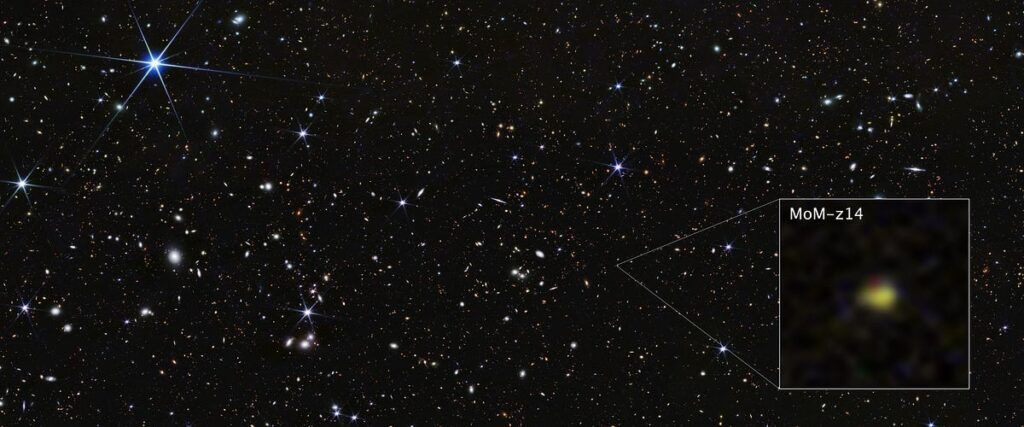
Discovery of MoM-z14: A Galactic Milestone
In a groundbreaking achievement, scientists using NASA’s James Webb Space Telescope have identified the farthest galaxy ever recorded. Named MoM-z14, this celestial body emerged just 280 million years after the Big Bang. This discovery sets a new benchmark in our understanding of the universe’s infancy. Read more about the discovery here.
Technology Behind the Discovery
The James Webb Space Telescope’s NIRCam (Near-Infrared Camera) and NIRSpec (Near-Infrared Spectrograph) were pivotal in identifying MoM-z14. These instruments allow astronomers to detect the faintest and oldest light in the universe, providing insights into the formation of the earliest galaxies. Learn more about James Webb Space Telescope.
The Role of Redshift
Redshift is a crucial concept in cosmology. It measures how much the wavelength of light stretches as the universe expands. MoM-z14 exhibits a redshift of 14.4, indicating its extreme distance and early formation. Explore the concept of redshift.
Implications for Cosmology
The discovery of MoM-z14 has significant implications for cosmology. It challenges existing models about the timeline of galaxy formation. Moreover, it provides a new perspective on the conditions of the early universe. As a result, scientists may need to revise theories about how galaxies evolved in the first billion years.
Expert Opinions and Future Research
Avi Loeb, a renowned astrophysicist, emphasized the importance of this discovery. He noted, “MoM-z14 opens a new window into the universe’s early epochs.” Furthermore, he suggests that future observations could reveal even older galaxies. Learn more about Avi Loeb’s work.
Subsequent studies will focus on analyzing MoM-z14’s properties, such as its mass and composition. Researchers anticipate that these findings could unlock further mysteries of the universe’s early stages.
Conclusion: A New Era in Astronomy
The discovery of MoM-z14 marks a significant milestone in astronomy. It highlights the capabilities of the James Webb Space Telescope and the potential for future breakthroughs. In conclusion, as technology advances, our understanding of the universe will continue to expand, unveiling the secrets of our cosmic origins.
Source Attribution: This article is based on information from Avi Loeb’s Medium article.
About The Author


