Interstellar 3I/ATLAS Reveals Post-Perihelion Secrets
2 min read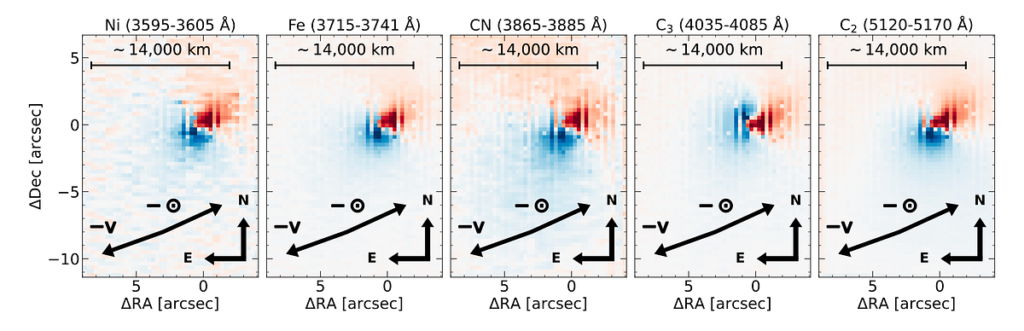
Unveiling 3I/ATLAS: An Interstellar Mystery
On November 16, 2025, scientists observed the interstellar object 3I/ATLAS after its closest approach to the Sun. This perihelion event, occurring on October 29, 2025, provided a unique opportunity to study an object from beyond our solar system. Researchers aimed to understand its composition and behavior using advanced spectrometry techniques.
3I/ATLAS is the third known interstellar object to visit our solar system. The first was ʻOumuamua, discovered in 2017. These objects offer a rare glimpse into the cosmic materials beyond our solar neighborhood.

Analyzing the Spectrum: Key Findings
During the post-perihelion analysis, researchers focused on deviations in the brightness distributions of key elements such as nickel (Ni), iron (Fe), cyanide (CN), tri-carbon (C3), and di-carbon (C2). These deviations provided critical insights into the object’s composition. Scientists noted excess flux in certain areas, depicted in red, while other regions showed a flux deficit.
The presence of nickel and iron suggests that 3I/ATLAS may share similarities with metallic asteroids in our solar system. Furthermore, the detection of carbon compounds like C3 and C2 indicated the presence of organic materials. This discovery raises intriguing questions about the potential for life-hosting elements in interstellar objects.

Implications for Astronomy and Astrobiology
Understanding the composition of 3I/ATLAS has profound implications for both astronomy and astrobiology. For instance, if interstellar objects frequently contain organic materials, they could play a significant role in spreading the building blocks of life across the galaxy. Consequently, this raises the possibility of panspermia, the hypothesis that life can travel between planets via celestial objects.
Moreover, the study of 3I/ATLAS’s spectrum helps refine models of how interstellar objects form and evolve. This can improve our understanding of the early solar system and the dynamic processes that govern celestial bodies.
Future Observations and Research
The findings from 3I/ATLAS underscore the importance of continued monitoring of interstellar visitors. As technology advances, astronomers hope to capture more detailed data on such objects. Future missions may involve spacecraft capable of closely examining these cosmic wanderers.
Furthermore, international collaboration remains essential. Organizations worldwide, including NASA and the European Space Agency, play crucial roles in these efforts. By sharing data and resources, scientists can enhance the precision and scope of their research.
Conclusion: A New Frontier in Cosmic Exploration
In conclusion, the study of 3I/ATLAS marks a significant milestone in our exploration of the universe. It opens up new avenues for understanding not only the materials that exist beyond our solar system but also the potential for life elsewhere in the galaxy. As a result, continued research into interstellar objects like 3I/ATLAS will be vital in the coming years.
For further reading, visit the original article by Avi Loeb on Medium.
Source Attribution: This article is based on information from the original source verified by Medium.
About The Author